Loop : Strategy
An AI intelligence layer that turns candidate rejection into recruiter brand equity.
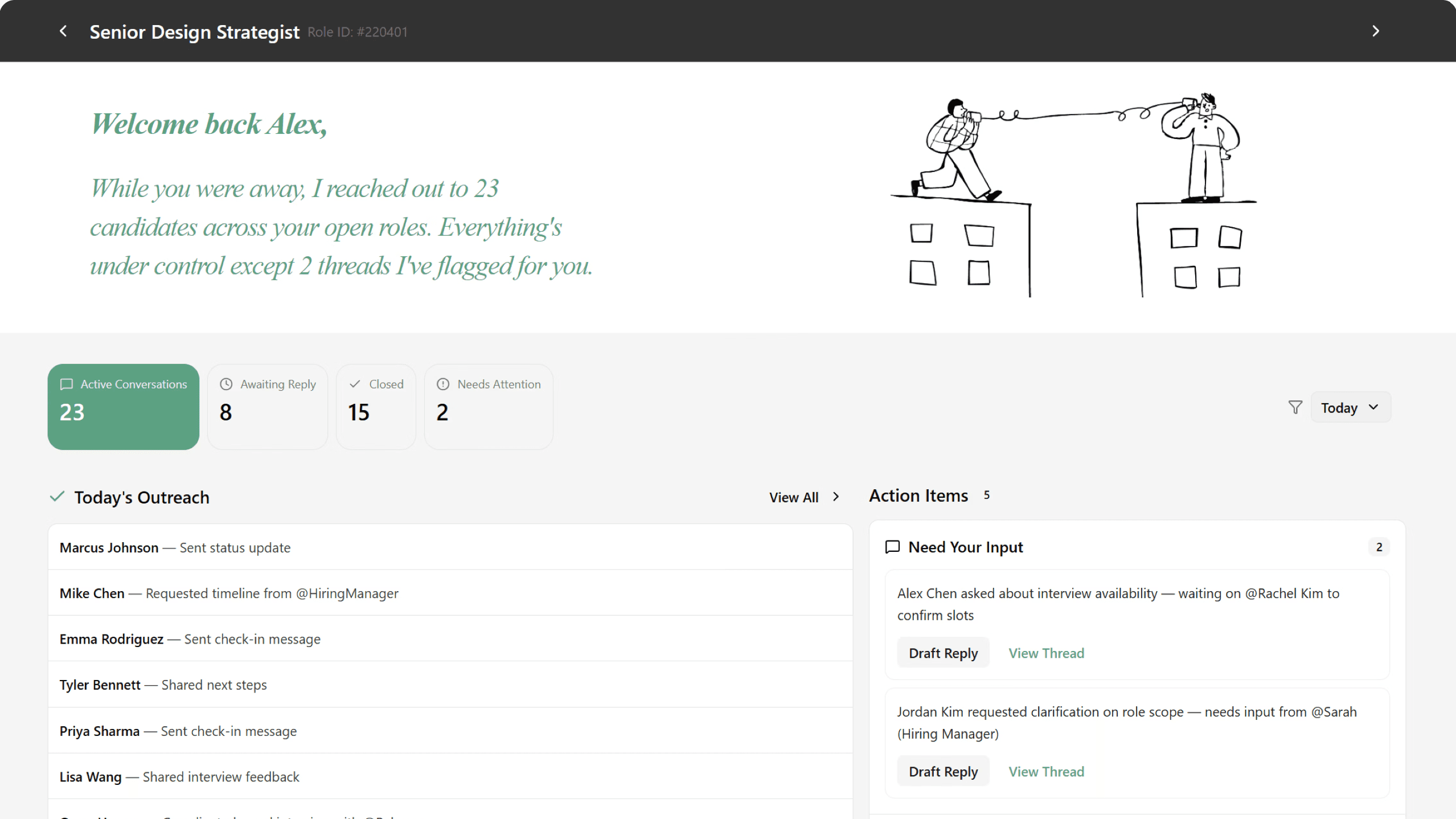
Overview
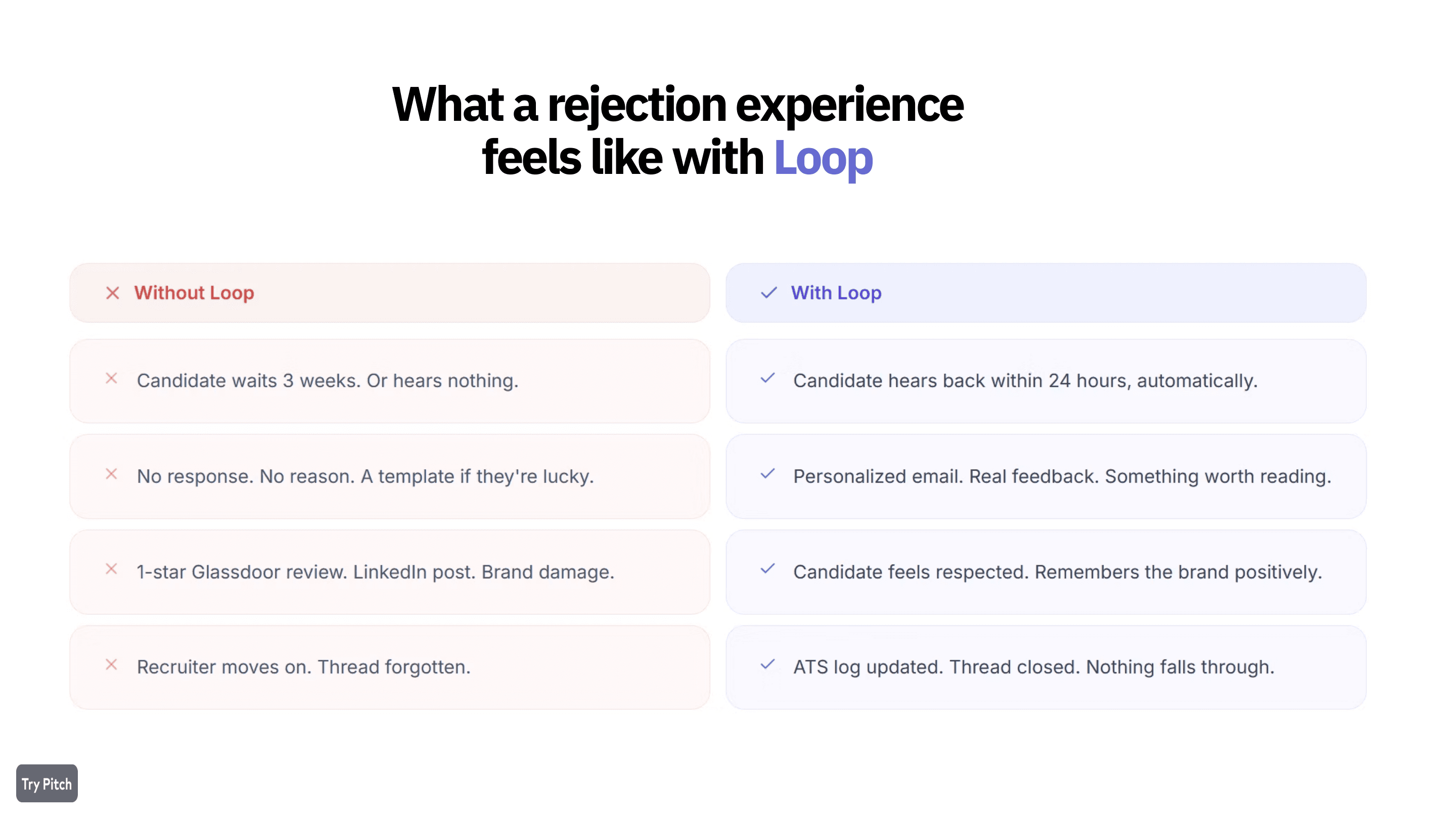
Every open role receives an average of 400 applications. One person gets hired. The other 399 hear nothing, or receive a generic template that tells them less than silence would. Ghosting is not a recruiter character flaw; it is a structural failure. Recruiters are buried under volume and manual process, and existing tools simply stop at the hiring decision. The rejection moment (the single highest-volume brand interaction most companies have) goes entirely undesigned.
Loop is an AI intelligence layer that autonomously manages rejection conversations on behalf of recruiters. I led product strategy and validation, building on six months of mixed-methods research into AI-driven hiring breakdowns. The core strategic reframe: rejection is not an HR operations problem. It is a brand equity problem.
Virgin Media discovered this the hard way: 18% of their 123,000 rejected applicants were existing customers, and 6% cancelled their subscriptions after a poor rejection experience. Published behavioral research confirmed the pattern: positive rejection experiences fully mitigate negative effects, while silence or generic templates actively erode employer brand perception. The rejection moment is a measurable business liability, not an HR inconvenience.
Current State
ATS platforms manage candidate pipelines up to the hiring decision. After rejection, candidates enter a communication void, receiving either a generic template email or total silence. No market player handles what happens after 'no.' Recruiters lack the bandwidth, and existing tools lack the capability.
Desired State
An intelligent layer that activates after the hiring decision, autonomously managing personalized rejection conversations, closing the loop with constructive feedback, handling follow-up questions, and converting a negative moment into brand equity.
ATS market analysis: every major platform drops the candidate at the rejection decision. The post-rejection journey is undesigned territory.
How Loop Works
Loop is not a chatbot bolted onto an ATS. It is an AI intelligence layer trained on organizational context: company structure, team skill graphs, hiring trends, and culture-versus-talent profiles. It activates at a specific moment: after the first human interview round, when the recruiter has decided to reject a candidate but lacks the bandwidth to communicate that decision meaningfully.
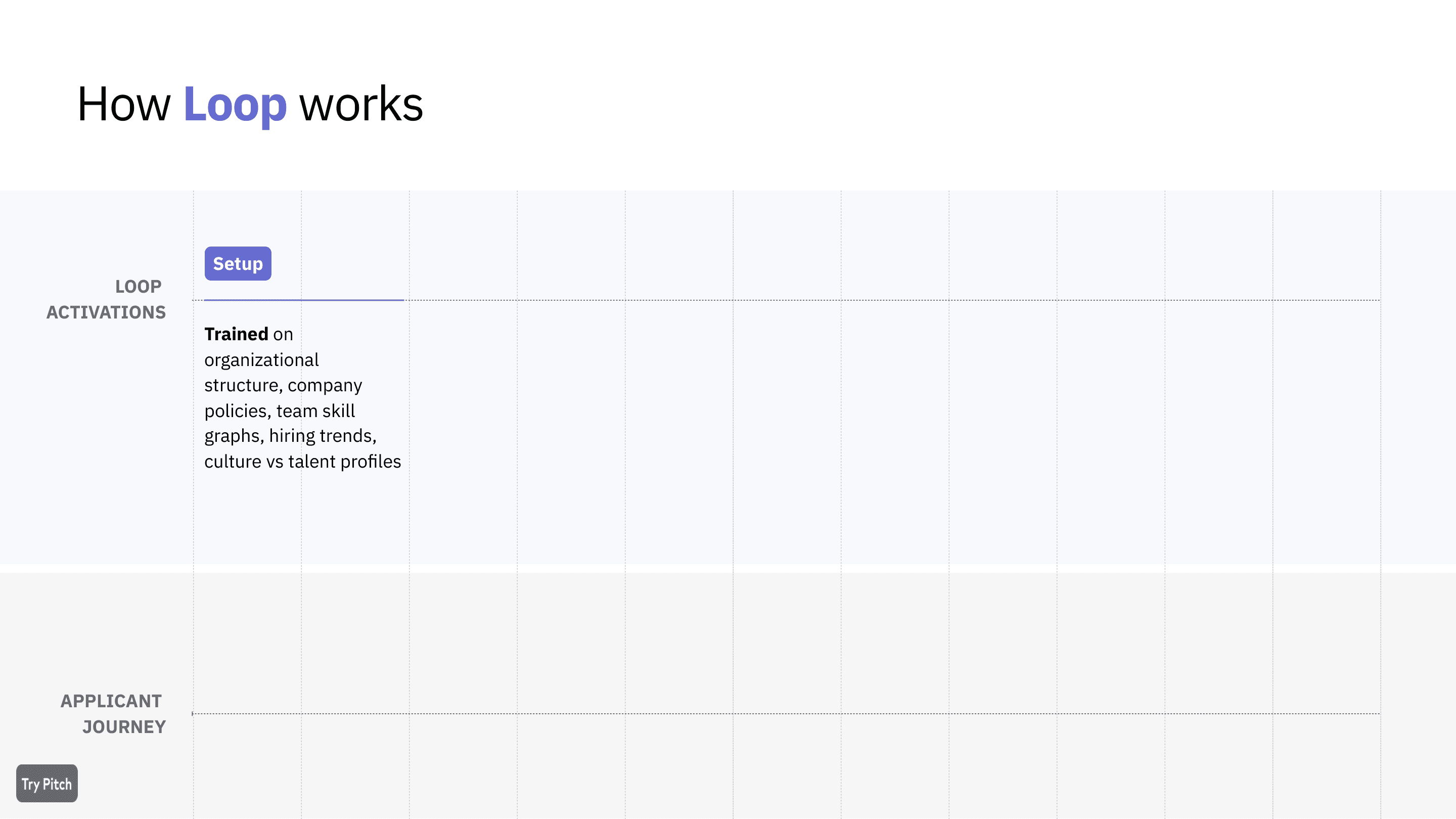
Loop ingests organizational context: structure, policies, team skill graphs, hiring trends, and culture-versus-talent profiles. We designed this as a prerequisite because generic rejection is what candidates already get. Without company-specific context, Loop would just be a faster template.
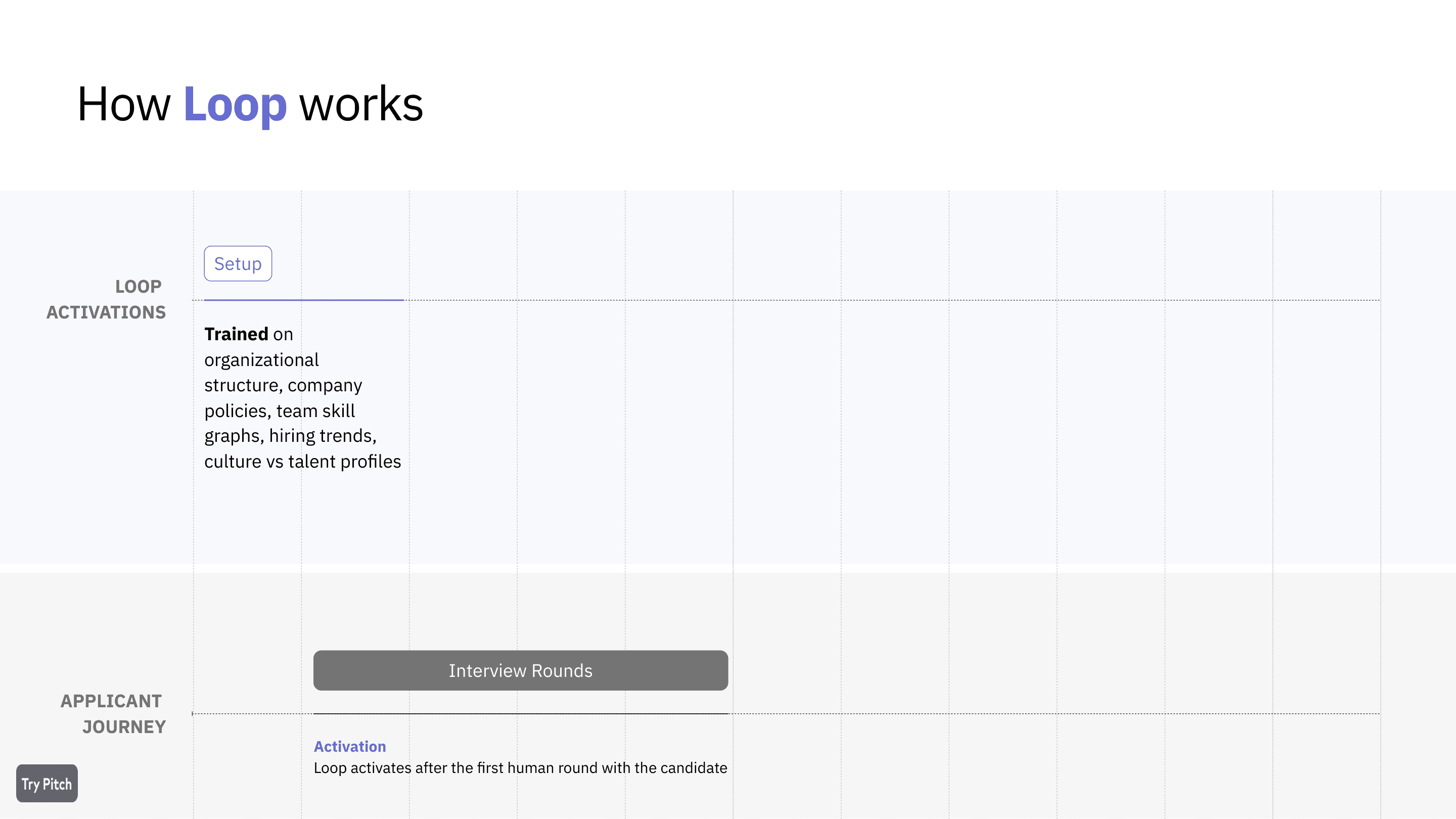
Loop activates after the first human interview round. We chose this trigger point deliberately: earlier and there's no meaningful feedback to give; later and the candidate has already been ghosted. The recruiter makes the rejection decision; Loop handles the communication.
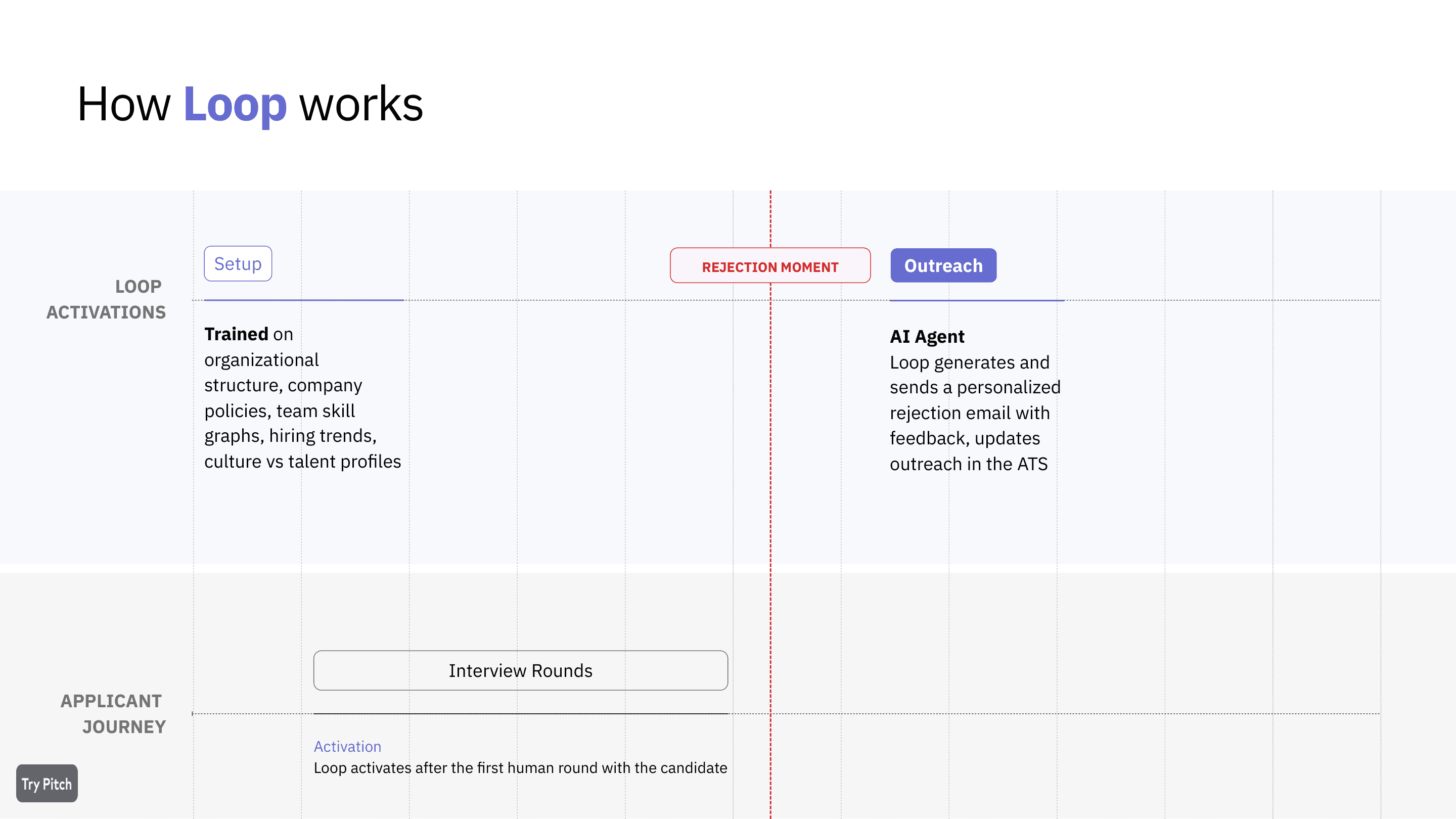
Loop transforms raw interview notes into a personalized rejection email with constructive, role-specific feedback. The tone was designed to be direct but warm: no corporate hedging, no false encouragement. Specific enough to be useful, honest enough to be respected.
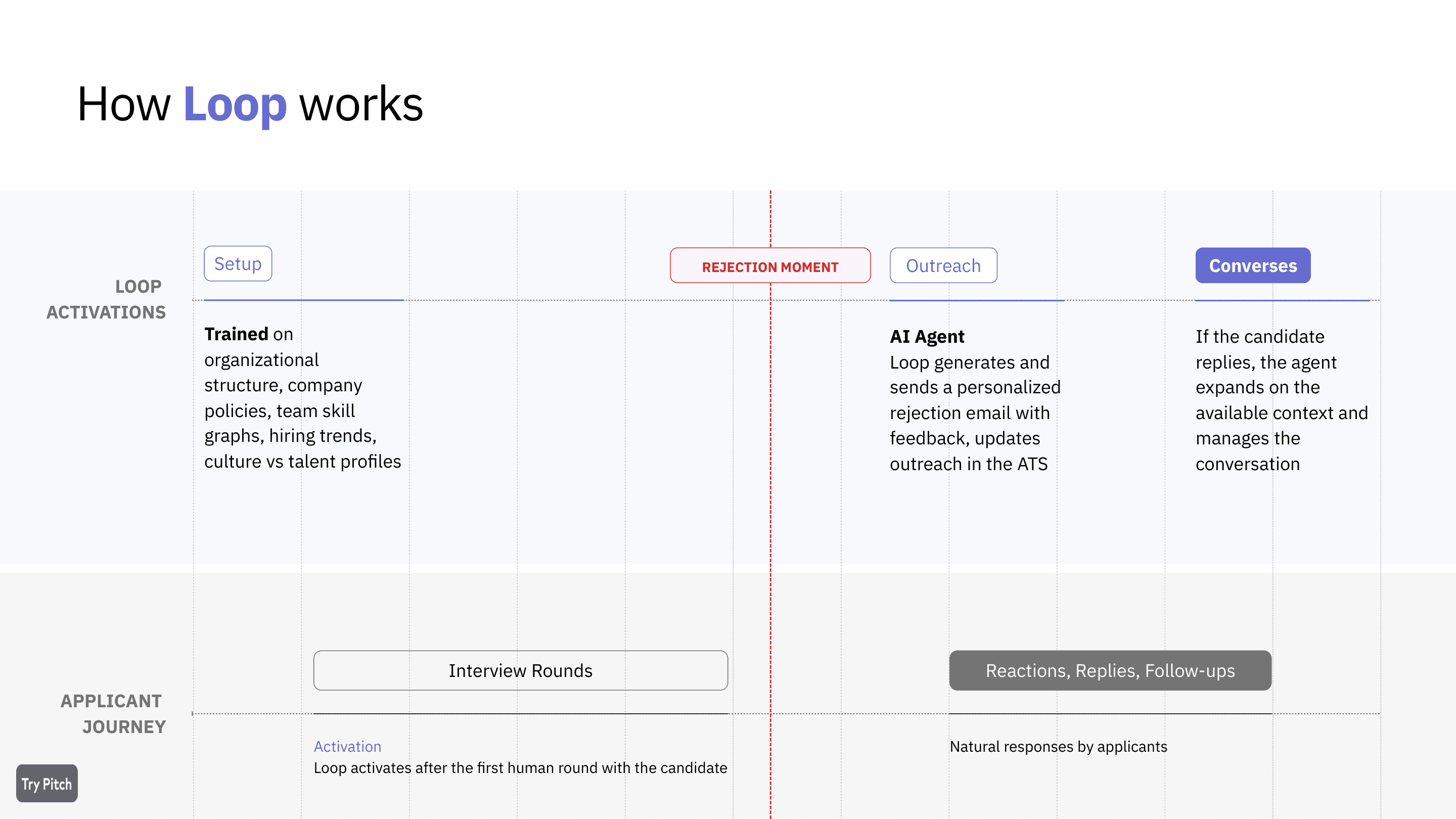
If the candidate replies, Loop manages follow-up questions. A key design constraint: responses are growth-focused and never numerical. When candidates asked 'rate me 1-10,' Loop redirects to actionable self-improvement without feeling evasive, because ranking candidates against each other undermines the dignity the rejection was designed to preserve.
Loop closes conversations gracefully, ensuring every candidate reaches a dignified endpoint rather than fading into silence. The closing pattern was iterated through applicant workshops until participants consistently described it as complete rather than abrupt.
From raw interview notes to personalized rejection with constructive feedback: the core transformation Loop performs.
Designing the Conversation
The hardest design challenge was tone. Automated rejection easily reads as cold or performative. We iterated through three tonal registers: clinical, empathetic-corporate, and direct-warm. We tested each with applicants. Direct-warm won consistently: specific about what happened, honest about the decision, and focused on what the candidate could do next. No softening language, no hollow encouragement.
The conversation design followed a principle we called 'structured honesty.' Loop discloses what it can (process-specific feedback, skill gaps observed, team composition context) and draws clear boundaries around what it cannot (comparative rankings, internal deliberation, numerical scores). Candidates respected the boundaries more when they were explicitly stated than when information was deflected.
Concept Testing with Stakeholders
We tested the Loop concept with recruiting professionals across organizations, with particular focus on high-volume hiring contexts where rejection communication breaks down most severely. The concept resonated strongest in environments with 12-month hiring cycles, where the scale of unmanaged rejections compounds into measurable reputation risk.
Stakeholders immediately grasped the strategic value: this was not about making recruiters' lives easier, it was about protecting the organization from a brand liability that scales linearly with hiring volume.
Stakeholder Validation
Recruiters validated both the problem severity and Loop's positioning, framing reputation risk as the primary concern, not workflow efficiency.
“Especially for really high-volume roles, or recruiting departments that routinely have both high-volume roles and many recs at the same time. I think this concept could be a real gamechanger.”
Recruiting Professional, Concept Testing Session
Vignette Study with Applicants
To validate the candidate-facing experience, we conducted a vignette study using a functional prototype built on the Claude API. Participants received a Loop-generated rejection email based on realistic interview scenarios, then interacted with the conversational agent in real time, asking follow-up questions, probing for detail, and testing boundaries.
The most revealing moments came when candidates pushed back. One asked Loop to rate their application on a scale of 1 to 10. Another asked what the hired candidate had that they lacked. These were the interactions we designed for — and the ones that proved the conversation architecture worked. Loop redirected without deflecting, and candidates described the experience as respectful rather than evasive.
The rejection email: specific, constructive, and grounded in the candidate's actual interview performance.
Follow-up conversation: growth-focused responses that answer hard questions without ranking or comparing candidates.
It's easily a 30-40% improvement over a standard rejection. The company feels more humanistic, like it actually cares.
Applicant, Vignette Study Participant
Boundary Testing
Candidates tested the AI's limits by asking for numerical ratings and comparative rankings — the exact scenarios that reveal whether conversation design holds under pressure.
“If you had to rate my application between 1-10, what would the recruiter rate it? What qualities worked best for the hired candidate?”
Applicant Questions During Vignette Study
Four-Dimensional Value Proposition
Loop's value proposition operates across four distinct dimensions, each addressing a different stakeholder need. This was a deliberate strategic choice: a single-value-prop product in this space would be dismissed as a nice-to-have. Loop needed to be defensible across brand, operations, candidate experience, and internal retention to earn budget allocation.
Value Proposition Framework
Brand Equity
Turns rejected applicants into brand ambassadors. Every rejection becomes a positive brand touchpoint instead of a reputation liability.
Recruiting Operations
Reduces manual effort on rejection communication autonomously. Recruiters reclaim bandwidth for evaluation and relationship-building.
Applicant Experience
Rejection with dignity. Growth-focused feedback that preserves self-worth and separates the outcome from the person.
Recruiter Retention
Reduces emotional labor and burnout from delivering bad news at scale. Contributes to lower recruiter turnover year-over-year.
Market Validation
To validate real-world demand beyond research participants, we launched a go-to-market experiment: a waitlist website, a LinkedIn company page running three posts per week with boosted ads targeting founders and talent acquisition specialists, and a pricing model stress-tested against competitor pricing in the ATS ecosystem. The goal was not to build a business — it was to generate a demand signal strong enough to validate that the problem we identified in research was felt acutely enough for people to raise their hand.
Early results confirmed the signal: 12 waitlist signups from targeted outreach, over 3,000 impressions across LinkedIn campaigns, and 2,100 community members reached. Small numbers for a launch, meaningful numbers for a concept validation from a two-person team with no marketing budget beyond a boosted post.
Go-to-market experiment: waitlist site, LinkedIn company page, and targeted ad campaigns validating demand signal.
Outcome
Loop demonstrated that the rejection moment (the single most neglected touchpoint in the hiring funnel) is designable, automatable, and strategically valuable. The concept was validated across three dimensions: stakeholders confirmed the business case, applicants confirmed the experience quality, and market signals confirmed real-world demand.
The deeper finding was about AI's role in sensitive communication. Loop works not because it pretends to be human, but because it provides what humans intend but consistently fail to deliver at scale: timely, specific, growth-oriented feedback after a difficult decision. The constraint was empathy, and the AI honored it.